logo
K&I Logo

ABOUT K&I LAWYERS

K&I Lawyers is an immigration law firm co-founded by Attorneys Rie Kotokawa and Satoru Isohata, with the same goal of providing excellent services to our clients. K&I Lawyers limits its practice to US immigration law and the related areas and utilizes the most advanced technology in doing so. This benefits you as clients because we are able to deliver the most up-to-date and accurate information to you in a timely manner. In addition, because attorneys of K&I Lawyers are fluent in both Japanese and English, they can explain laws and application processes, which are often very complex without a translator. Therefore, you do not have to worry about important nuances being lost in translation. Most importantly, because we are a small, well-structured firm, we can eliminate unnecessary barriers between clients and attorneys and establish a close and intimate relationship directly with clients. What this means to you is that you have a direct access to our attorneys without a paralegal standing in between. All matters entrusted to us will be handled personally by Attorney Rie Kotokawa or Attorney Satoru Isohata, or together as a team. When you retain us, you have our guarantee that we will do our absolute best to attain the results you are looking for. Finally, at K&I Lawyers, we believe that by being able to offer high quality services at reasonable costs, our value is unparalleled.

Key features of our firm

To the top

ATTORNEYS

Rie Kotokawa

Founder & Partner

Attorney Rie Kotokawa is originally from Tokyo, Japan and has lived in the United States since she was 16 years old. She earned her Bachelor of Arts degree in Economics from the Seattle University and Juris Doctor degree from the Detroit College of Law at Michigan State University. Before opening her own practice in Bellevue, Washington, she worked for one of the prominent immigration law firms in New York City where she gained experience in handling a wide variety of business and family-based immigration cases. She opened Law Office of Rie Kotokawa in Bellevue, Washington in July 2002. In 2006, she was joined by Attorney Satoru Isohata, and together, they found K&I Lawyers. Ms. Kotokawa is admitted to practice law in both Washington and New York. She is also an active member of the American Immigration Lawyers Association and the Washington State Bar Association. She is fluent in both English and Japanese.

Satoru Isohata

Founder & Partner

Attorney Satoru Isohata was born in Kobe, Japan. He earned his Bachelor of Arts degree from Meiji University in Tokyo, Japan and Juris Doctor degree from Washburn University in Topeka, Kansas. Prior to co-founding K&I Lawyers, he worked for various law firms and served national and international clients in the area of immigration law, family law and wills and estate. Mr. Isohata is admitted to practice law in both Washington and Kansas and is an active member of the American Immigration Lawyers Association, Washington State Bar Association and Kansas Bar Association.

To the top
Visas

VISAS

×
Visa Waiver Program

Under the Visa Waiver Program, the citizens of certain countries may visit the US for business or pleasure for up to 90 days without a visa.

If you enter the US under this program, you cannot extend your stay past 90 days except for very limited circumstances or change to another nonimmigrant status while in the US. Therefore, if you are a citizen of a qualified country but plan to stay past 90 days or to change your status in the US, you may want to consider obtaining a nonimmigrant visa such as B-1 or B-2.


×
B-1 Business Visitor Visas

B-1 visas are available to those who wish to enter the US for business purposes that do not involve receiving salary or payment of any kind from a US source. B-1 visas are appropriate for those who want to set up investments or new enterprises, attend professional conferences, conventions or seminars, make purchases and negotiate contracts, among others.

How to Qualify:
  1. You must be coming to the US temporarily for business purposes that do not involve receiving salary or payment of any kind from a US source,
  2. You have sufficient funds to cover the expenses of the visit and return transportation,
  3. You have a residence abroad which you have no intention of abandoning, and
  4. You intend to return home at the end of your visit

×
B-2 Visitor Visas

B-2 visas are available to those who wish to enter the US for pleasure such as tourism, visiting friends and relatives, participating in convention or conferences of social organization, participating in events as amateurs and receiving medical care, among others.

How to Qualify:
  1. You must be coming to the US temporarily for pleasure,
  2. You have sufficient funds to cover the expenses of the visit and return transportation,
  3. You have a residence abroad which you have no intention of abandoning, and
  4. You intend to return home at the end of your visit.

×
K-1 Fiance(e) Visas

K-1 fiance(e) visas are available to fiance(e)s of US citizens to enter the US for the sole purpose of completing a valid marriage to each other. They are not available to fiance(e)s of green card holders. K-1 fiance(e)s' unmarried children under 21 years of age are given K-2 derivative status if they are accompanying or following to join the K-1 fiance(e)s.

K-1 visas are valid for 6 months for a single entry only, and the fiance(e) must enter the US within this period. The foreign fiance(e) must marry the US citizen petitioner within 90 days after his or her arrival in the US and file for adjustment of status. If the foreign fiance(e) does not marry the US citizen petitioner within 90 days, the foreign fiance(e) will be required to depart from the US, and failure to depart will render him or her removable. K-1 fiance(e)s cannot file for adjustment of status based on the marriage to someone other than the US citizen who has petitioned his or her K-1 fiance(e) visa. Furthermore, K-1 fiance(e)s are not eligible for an extension of stay or change of status. K-1 visas are automatically terminated when the US citizen petitioner dies or withdraws the petition.

How to Qualify:
  1. The US citizen petitioner and the foreign fiance(e) have met in person within the last 2 years prior to the date of filing the petition, unless this requirement is waived,
  2. They have a bona fide intention to get married, and
  3. They must be legally able and willing to get married within 90 days after the foreign fiance(e) arrives in the US.

×
E-1 Treaty Trader Visas

E-1 visas are based on trade treaties between the US and an applicant's country of nationality.

E visa holders are generally admitted for a period of 2 years although E visa stamps are usually granted in 5 year increments. Unlike H-1B and L visas, there is no limit on the number of extensions allowed for E visas. Unlike H-1B visas, E visas are not subject to prevailing wages or an annual cap. Unlike L visas, E visas do not require prior employment with the sponsoring employer or its affiliates abroad.

How to Qualify:
  1. A trade treaty must exist between the US and your country,
  2. At least 50% of the company is owned by nationals of your country,
  3. The owners of the company must either maintain E nonimmigrant status if they are in the US or live outside the US and be eligible for E nonimmigrant status if they were to live in the US. This means that owners who are also US citizens or green card holders cannot be counted toward determining at least 50% ownership, even if they are nationals of your country,
  4. You are either an owner of the company or an employee in a managerial or executive capacity or with essential skills,
  5. The company has already been engaged in substantial trade principally between the US and your country. The trade must be substantial in terms of dollar amount, volume and frequency, and
  6. You intend to depart from the US when your E-1 status terminates.

×
E-2 Tready Investor Visas

E-2 visas are based on investment treaties between the US and an applicant's country of nationality.

E visa holders are generally admitted for a period of 2 years although E visa stamps are usually granted in 5 year increments. Unlike H-1B and L visas, there is no limit on the number of extensions allowed for E visas. Unlike H-1B visas, E visas are not subject to prevailing wages or an annual cap. Unlike L visas, E visas do not require prior employment with the sponsoring employer or its affiliates abroad.

How to Qualify:
  1. An Investment treaty must exist between the US and your country,
  2. At least 50% of the company is owned by nationals of your country,
  3. The owners must either maintain E nonimmigrant status if they are in the US or live outside the US and be eligible for E nonimmigrant status if they were to live in the US. This means that owners who are also US citizens or permanent resident cannot be counted toward determining at least 50% ownership, even if they are nationals of your country,
  4. You are either an owner of the company or an employee in a managerial or executive capacity or with essential skills,
  5. The owner either has already made a substantial investment or is actively in the process of making a substantial investment in the US enterprise. The investment must be substantial in terms of dollar amount, capitalization and job creation, but what is considered substantial depends on the type of business, and
  6. You intend to depart from the US when your E-2 status terminates.

×
H-1B Professional Worker Visas

H-1B visas are available to those who wish to enter the US to perform services in a specialty occupation, requiring at least a bachelor's degree or equivalent work experience in a specialized field. While H-1B visas are typically used by holders of a US bachelor's degree, they are also available to those who have obtained their education or equivalent work experience abroad. As no prior work experience is required, H-1B visas are frequently utilized by US companies wishing to employ foreign workers who have recently attained a US bachelor's degree in a specialized field. H-1B visa holders are allowed to have "dual intent".

H-1B visas are subject to an annual cap of 65,000. However, 6,800 of those are set aside for nationals of Chile and Singapore. Therefore, in actuality, there are only 58,200 H-1B visas available for any fiscal year (October 1 – September 30).

There are some cap-exempt petitions:
  1. You are already in H-1B status and wish to extend your status or change your employer.
  2. You have been granted H-1B status in the past 6 years and have not left the US for longer than 1 year since attaining such status.
  3. You are a physician who has received a J-1 waiver of the 2-year home residency requirement.
  4. Your sponsoring employer is an institution of higher education or a nonprofit organization or entity related to or affiliated with an institution of higher education or a nonprofit research organization or a governmental research organization.
  5. You have earned a US master’s or higher degree (the first 20,000 H-1B petitions).

H-1B visa holders may be admitted for up to a maximum initial period of 3 years. H-1B visas may be extended for 3 years with a total maximum period of 6 years. If you have reached the maximum period of stay, you are generally barred from reentering the US in either H or L status until you have resided abroad for 1 year.

There is an exception to this general rule, however. In November 2002, President Bush signed the 21st Century Department of Justice Appropriations Authorization Act (H.R.2215) into law. Under this new law, if 365 days or more have elapsed since the filing of a labor certification application or an immigrant visa petition, H-1B status may be extended in 1 year increments until a final decision is made. When a labor certification application, an immigrant visa petition or an application for adjustment of status is denied, the extended H-1B status will be terminated immediately. If the employment-based immigrant visa petition (I-140) is approved, H-1B status may be extended in 3 year increments.

Spouse and unmarried children under 21 years of age of H-1B visa holders may obtain H-4 visas.

How to Qualify:
  1. You have a bachelor’s degree or the equivalent in education and/or experience (3 years of experience can be substituted for each year of college-level education that you lack),
  2. Your job must be a specialty occupation,
  3. There is a nexus between the job offered and your background (education and/or experience),
  4. If the job has a license requirement, you have that license,
  5. You have a job offer by a US employer, and
  6. Your employer must pay you the prevailing wage for the position or the actual wage, whichever is higher. Your employer must also offer you the same benefits it offers to other workers in the same or similar position.

×
I Representative of Foreign Information Media Visas

I visas are commonly known as journalist visas and are available to members of the foreign information media who wish to enter the US on assignment. I visas cover a wide range of information media outlets and can be quite useful.

Representatives of foreign information media include members of the foreign press, radio, television, film or other information media who are involved in the production of documentary or newsworthy events, or informational or educational material. Reporters, journalists, photographers, film crews, editors and freelance media workers under contract as well as employees of independent production companies who hold credentials issued by a professional journalistic association are all eligible for the I visa classification.

Representatives of foreign information media on I visas must be paid by the sponsoring foreign media and may not receive salary or payment of any kind from a US source. I visa holders may be admitted for the duration of employment or assignment, and there is no limit on the number of extensions allowed for I visas.

Representatives of foreign information media on I visas must be paid by the sponsoring foreign media and may not receive salary or payment of any kind from a US source. I visa holders may be admitted for the duration of employment or assignment, and there is no limit on the number of extensions allowed for I visas.

How to Qualify:
  1. You are a representative of a foreign press, radio, film or other information media,
  2. You must be entering the US on assignment for the sponsoring foreign media,
  3. You are paid by the sponsoring foreign media, and
  4. You must work on the production of documentary or newsworthy events, or informational or educational material in the US.

×
R-1 Religious Worker Visas

R-1 visas are available to religious workers who seek to enter the US to perform services related to their religious vocation or occupation. Religious workers include (i) ministers, (ii) professional religious workers who engage in an activity in a religious vocation or occupation for which the minimum of a US bachelor's degree or a foreign equivalent degree is required and (iii) other religious workers who engage in a religious vocation or occupation which relates to a traditional religious function.

A religious occupation is defined as an activity that relates to a traditional religious function such as liturgical workers, religious instructors, religious counselors, workers in religious hospitals, religious translators and religious broadcasters, among others.

A religious vocation means a calling to religious life evidenced by the demonstration of commitment practiced in the religious denomination such as the taking of vows. Persons with religious vocations such as nuns, monks and religious brothers and sisters may engage in any types of activity within their denomination or its affiliate.

R-1 visa holders may be admitted for up to a maximum initial period of 3 years. R-1 visas may be extended for 2 years with a total maximum period of 5 years. If you have reached the maximum period of stay, you are barred from reentering the US in R status until you have resided abroad for 1 year.

How to Qualify:
  1. You have been a member of the denomination for 2 years immediately preceding admission,
  2. You are a member of a religious denomination having a bona fide nonprofit, religious organization in the US,
  3. The religious denomination and its affiliate must be exempt from taxation under 503(c)(3) of the Internal Revenue Code, or it must qualify for tax-exempt status, and
  4. You must be entering the US solely to carry on the vocation of a minister of the religious denomination, or at the request of the organization, to work in a religious vocation or occupation for the denomination or for an organization affiliated with that denomination, whether in a professional capacity or not.

×
L-1 Intracompany Transferee Visas

L-1 visas are designed to transfer executives or managers (L-1A) or employees with specialized knowledge (L-1B) within an international organization to its US based operation. L-1 visa holders may be admitted for up to a maximum initial period of 3 years (with 1 year exception for a new office situation).

L visas may be extended in 2 year increments with a total maximum period of 7 years for L-1A executives and managers and 5 years for L-1B specialized knowledge personnel. If you have reached the maximum period of stay, you are barred from reentering the US in either H or L status until you have resided abroad for 1 year. If you wish to remain in the US beyond the maximum period of stay, you may want to consider switching to E visas or applying for a green card. L-1 visa holders are also allowed to have dual intent.

L visas are often utilized when a foreign company opens a new office in the US. The initial period that can be granted in these circumstances is limited to 1 year. Within this 1 year, the US based business must become fully operational, or an extension will not be granted. The law does not specifically provide what the US based business must accomplish within this 1 year period. Rather, it is determined on a case-by-case basis. However, if the US based business is underdeveloped with no employee other than the L visa holder, or it has not generated adequate income, it does not appear favorably in the eyes of an USCIS officer reviewing your extension application.

Because the labor certification is not required for multinational executives or managers, if applying for an immigrant visa is a possibility in the future, obtaining L-1A visas may be beneficial. Furthermore, if the US based business has been doing business for at least 1 year, and you can satisfy the L-1A visa requirements, you may be eligible to apply for a green card directly.

How to Qualify:
  1. You have been continuously employed abroad full time for at least 1 of the last 3 years prior to entering the US in L status,
  2. You have been employed abroad as an executive, manager or person with specialized knowledge,
  3. The company you have worked for abroad is a branch, parent, subsidiary, joint venture partner or affiliate of the US company,
  4. You must continue to work either in an executive or managerial capacity or in a position that requires specialized knowledge for the US company, and
  5. The company must continue to do business in the US and at least one other country for the duration of your L-1 visa.

×
TN Visas for Canadian and Mexican Professionals

TN (Trade NAFTA) visas are available to Canadian and Mexican professionals in certain professions under the North American Free Trade Agreement.

The process of applying for TN visas differs for Canadian and Mexican citizens. Canadian citizens may make an application for TN visas at the border by presenting necessary documentation, and a decision will be rendered on the same day. Canadian citizens do not need to obtain TN visas at a US consulate. Mexican citizens must obtain TN visas before they are admitted to the US in TN status. The applicants may be admitted for up to a maximum initial period of 3 years, and extensions may be granted in 3 year increments with no limit on the number of extensions.

Unlike H-1B visas, there is no prevailing wage requirement for TN visas. TN visas are not subject to an annual cap. However, the USCIS does not recognize "dual intent" for holders of TN status; therefore, if you start the permanent resident process while maintaining TN status, you may encounter some issues and concerns in maintaining or extending your TN status. Furthermore, unlike H-1B visas, TN applicants cannot establish equivalency to a bachelor's degree by showing a combination of experience and education for TN purposes.

Spouse and unmarried children under 21 years of age of TN visa holders may obtain TD visas. Spouses of TN visa holders are not allowed to engage in employment in the US. Spouses and children do not need to be citizens of Canada or Mexico to receive TD visas.

How to Qualify:
  1. You must be a Canadian or Mexican citizen (permanent residents are not eligible),
  2. You have an offer of employment from an employer in the US,
  3. You must engage in employment in one of the approved professions listed under the NAFTA (Appendix 1603.D.1),
  4. You possess the necessary credentials for that profession. A bachelor's degree or higher is usually required unless alternative qualifications are specifically permitted, and
  5. You intend to depart the US when your TN status terminates.

×
O-1 Individual of Extraordinary Ability Visas

O-1 visas are available to those who possess extraordinary ability in the sciences, arts, education, business or athletics. Extraordinary ability is defined differently depending upon the field of endeavor. Extraordinary ability in the sciences, education, business or athletics must be demonstrated by a level of expertise indicating that the person is one of the small percentages that has risen to the top of his or her field. The field of arts is defined very broadly and includes performing arts, fine arts, visual arts and culinary arts, among others. Extraordinary ability in the arts must be demonstrated by distinction. Distinction is defined as a high level of achievement in the field evidenced by a degree of skill and recognition substantially above that ordinarily encountered to the extent that the person is described as prominent, renowned, leading or well known in the field.

O-1 individuals of extraordinary ability are initially admitted for a period of 3 years or for the time necessary to complete the event or activity or group of events or activities, whichever is less. Because there is no limit on the number of extensions allowed for O-1 visas, extension may be obtained to continue or complete the same events or activities in 1 year increments.

How to Qualify:
  1. You have extraordinary ability in the sciences, arts, education, business or athletics,
  2. Your extraordinary ability is demonstrated by sustained national or international acclaim,
  3. Your achievements is recognized in the field through extensive documentation,
  4. You must be entering the US to continue working in your field of endeavor, and
  5. A consultation from an appropriate peer group or labor organization in the field must be obtained. In the case of television and motion picture, a consultation from a management organization is also required.

×
P Athlete and Entertainer Visas

P visas are available to athletes and entertainers who wish to enter the US temporarily to perform in a competition, event or performance but may not meet the extraordinary ability standard required for the O visa category. Generally speaking, P visas are more appropriate for group entertainers. For athletes, P visas are easier to obtain.

There are 3 types of P visas: P-1 Visas

P-1 visas are available to internationally known athletes, individually or as part of a group or team and entertainment groups.

Individual athletes, athletic teams and entertainment group must be internationally recognized. International recognition is defined as "a high level of achievement in the field evidenced by a degree of skill and recognition substantially above that ordinarily encountered, to the extent that such achievement is renowned, leading or well known in more than one country." Athletes themselves must be internationally recognized. In addition, if it involves a team sport, an athletic team itself must have achieved international recognition in the sport.

Individual entertainers must be part of an entertainment group that has been internationally recognized as outstanding in the field for a sustained period of time. The individual entertainers must have had a sustained relationship with the group, generally 1 year with some exceptions. The entertainment group, not individual entertainers must be internationally recognized. Individual members of the entertainment industry are not eligible for P-1 category. Rather, they should look into the O visa category.

P-2 Visas

P-2 visas are available to artists or entertainers, individually or as part of a group involved in a reciprocal exchange program between an organization in the US and one or more foreign countries which provides for the temporary exchange of artists and entertainers.

P-3 Visas

P-3 visas are available to culturally unique artists and entertainers, individually or as part of a group to perform, teach or coach their particular art or discipline. Culturally unique means "a style of artistic expression, methodology or medium which is unique to a particular country, nation, society, class, ethnicity, religion, tribe or other group of persons.

All 3 categories include essential personnel.

Spouse and unmarried children under 21 years of age of P visa holders may obtain P-4 visas. However, spouses of P visa holders are not allowed to engage in employment in the US.

Admission in the P visa categories is limited to a specific competition, event or performance. Individual athletes may be admitted for 5 years, and it may be extended for up to 5 years with a total maximum period of 10 years. Others may be admitted for the time needed to complete the competition, event or performance, not to exceed 1 year. Extensions are granted up to 1 year at a time to continue or complete the activity for which they were admitted.


To the top
Green Card

FAMILY-BASED GREEN CARD

Family-based immigration is the most common way for foreign nationals to obtain US permanent residency (green card). Keeping families together has traditionally been an important concept of the US immigration law. The Immigration and Nationality Act allows US citizens and green card holders to sponsor their close relatives for green cards based upon their family relationships. However, the number of green cards that may be issued annually to close relatives of US citizens and green card holders are limited based on the qualifying relationships, the date the petition is filed and the nationality of the relatives.

×
Application Categories Qualifying Family Relationships

There are two types of qualifying family relationships: Immediate relatives and family-based preference relatives.

  1. Immediate Relatives include:
    1. Spouses of US citizens
    2. Unmarried Children under 21 years of age of US citizens
    3. Parents of US citizens if the citizen is at least 21 years of age, and
    4. Spouses of deceased US citizens if:
      1. They had been married to each other for at least 2 years at the time of the US citizen's death,
      2. They were not legally separated at the time of the US citizen's death,
      3. The foreign spouse filed a new petition within 2 years of the US citizen's death, and
      4. The foreign spouse has not remarried.

    There is no limit on the number of green cards available to the immediate relatives of US citizens in any given year. If your relatives qualify under this category, they can obtain a green card as soon as their application is processed.
  2. Preference Categories consist of:
    1. First Family-Based Preference, which covers Unmarried Sons and Daughters over 21 years of age of US citizens,
    2. Second Family-Based Preference, which covers Spouses and Unmarried Children of green card holders,
    3. Third Family-Based Preference, which covers Married Sons and Daughters of US citizens, and
    4. Fourth Family-Based Preference, which covers Brothers and Sisters of US citizens if the US citizen is at least 21 years of age.

    Family-based preference relatives are subject to annual numerical limitations. Your relatives cannot apply for a green card until their priority date becomes current.

×
Application Process

Applying for a green card based on a family relationship is generally a 2-step process: the I-130 relative petition and the application for a green card.

Step 1: I-130 Relative Petition

Your sponsoring relative files an I-130 relative petition on your behalf. The relative petition is filed with the USCIS regional service center that has jurisdiction over your sponsoring relative's place of residence. The purpose of this petition is to prove the qualifying family relationship between you and your sponsoring relative.

Step 2: Green Card Application

Once the relative petition is approved, and your priority date becomes current, you can then file an application for a green card. The purpose of this application is to conduct a comprehensive examination of your background including your medical and criminal history as well as your sponsor's financial status. If a green card is applied for in the US, the process is called "Adjustment of Status", and if outside the US, "Consular Processing". The result is the same: to obtain a green card.

There is an exception to this 2-step process. If you are an immediate relative of an US citizen, and you are applying for a green card through adjustment of status, you can complete your application in 1-step process by filing I-130 relative petition and I-485 application for adjustment of status simultaneously. This is so because a green card is immediately available to immediate relatives of US citizens.


×
Conditional Permanent Residence

A foreign national who has been married to a US citizen or green card holder for less than 2 years on the day that permanent residence is conferred is given a conditional green card for 2 years. The purpose of this condition is to prevent fraudulent marriages entered solely to evade the immigration laws. Except for this condition, the foreign spouse has the same rights as any other green card holders do. The foreign spouse may live and work in the US and travel freely in and out of the US. Furthermore, the time spent as a conditional green card holder counts toward the residency requirements for naturalization.

To remove the condition, the foreign spouse and the US citizen or permanent resident spouse must jointly file a petition within 90 days before the second anniversary of the foreign spouse's obtaining a conditional green card. If a joint petition is not filed in time, the foreign spouse may be removed from the US. If the joint petition is not possible because the marriage has been terminated by divorce or death; the foreign spouse has been battered by the US citizen or permanent resident spouse; or the US citizen or permanent resident spouse refuses to file a joint petition, the foreign spouse may be able to apply to waive the joint filing requirement. In either case, the USCIS is going to have the second and final chance to review the legitimacy of the marriage. If the parties are able to prove that the marriage was not entered into solely for the purpose of the foreign spouse's gaining a green card, the USCIS will remove the condition, and the foreign spouse will be given a regular green card.

If you have obtained a green card more than 2 years after your marriage to a US citizen or green card holder, you are not subject to the 2 year condition. Therefore, you will be given a regular green card from the outset.


×
Waiver of Joint Petition

A foreign national who has been married to a US citizen or permanent resident for less than 2 years on the day that permanent residence (green card) is conferred is given a conditional permanent residence for 2 years. To remove the condition, the foreign spouse and the US citizen or permanent resident spouse must jointly file a petition within 90 days before the second anniversary of the foreign spouse's obtaining conditional permanent residence.

The joint petition may not be possible for various reasons. The foreign spouse may be able to apply to waive the joint filing requirement in any of the following circumstances:

  1. The marriage was entered in good faith, but it was terminated through divorce or annulment;
  2. The US citizen spouse is deceased;
  3. The marriage was entered in good faith, but the foreign spouse or his or her child was battered by or was the subject of extreme cruelty by the US citizen spouse or step-parent; or
  4. The removal from the US would result in an extreme hardship.

A waiver application may be filed as soon as a basis for it arises even before the 90-day filing period for a joint petition. For instance, the foreign spouse may file a waiver application as soon as a divorce decree has become final.

Like the joint petition, the USCIS will review the legitimacy of the marriage; thus, the foreign spouse must submit evidence to prove that the marriage was entered in good faith. In addition, the foreign spouse must submit evidence establishing eligibility for the waiver application such as death certificate, divorce decree, reports from social service agency and psychologist, medical records, police reports, etc.

When the waiver application is filed, the USCIS will extend the foreign spouse's conditional resident status for the initial period of 12 months while the application is pending. Therefore, the foreign spouse may continue to reside and work in the US.


To the top
Green Card

EMPLOYMENT-BASED GREEN CARD

The Immigration and Nationality Act allocates approximately 140,000 employment-based immigrant visas per year. The employment-based immigration is comprised of 5 preference categories, which are commonly referred to as EB-1 through EB-5. Each category has the statutory eligibility requirements. The employment-based immigration generally requires either that a foreign national is one of the best in the field of endeavor or that there are no qualified US workers available to fill the position offered to the foreign worker. In the latter, a labor certification is required.

×
Application Categories
  1. First Employment-Based Preference (EB-1) is comprised of (i) Individuals of Extraordinary Ability, (ii) Outstanding Professors and Researchers and (iii) Multinational Executives and Managers. 28.6% of the total number of employment-based immigrant visas (approximately 40,000 visas) is allocated to foreign workers in these 3 subcategories. They are also commonly known as priority workers.
    1. Individuals of Extraordinary Ability in the Sciences, Arts, Education, Business and Athletics – To qualify as an individual of extraordinary ability, you must be one of the small percentage who has risen to the very top of your field. This subcategory requires neither a job offer nor a labor certification.
    2. Outstanding Professors and Researchers – To qualify as an outstanding professor or researcher, you must show that you:
      1. are internationally recognized as outstanding in a specific academic field,
      2. have a minimum of 3 years of experience in teaching and/or research in the field, and
      3. enter the US (i) in a tenure or tenure-track teaching or comparable research position at a university or other institution of higher education or (ii) in a comparable research position with a private employer who has at least 3 full-time researchers and has documented accomplishment in the field.
      No labor certification is required for this subcategory, but a job offer is required.
    3. Multinational Executives and Managers – This subcategory is reserved for executives and managers of multinational companies who are transferred to US based operation. No labor certification is required for this subcategory, but a job offer is required.
  2. Second Employment-Based Preference (EB-2) is comprised of (i) Individuals of Exceptional Ability and (ii) Professionals Holding Advanced Degree. 28.6% of the total number of employment-based immigrant visas (approximately 40,000 visas) is allocated to foreign workers in these 2 subcategories. Both a labor certification and a job offer are required except for limited circumstances.
    1. Individuals of Exceptional Ability in the Sciences, Arts or Business – To qualify as an individual of exceptional ability, you must show that you have a degree of expertise significantly above the ordinary. This may be demonstrated by extensive documentation showing significant achievements and recognition in the field.
    2. Professionals Holding Advanced Degree – To qualify as a member of the professions under this subcategory, you must have at least a US master’s degree or foreign degree equivalent and must establish that such a degree is the normal requirement for entry into the profession. The USCIS will accept a US bachelor’s degree or foreign degree equivalent, plus 5 years of progressive experience as an alternative to the master’s degree requirement.
  3. Third Employment-Based Preference (EB-3) is comprised of (i) Professionals, (ii) Skilled Workers and (iii) Unskilled Workers. 28.6% of the total number of employment-based immigrant visas (approximately 40,000 visas) is allocated to foreign workers in these 3 subcategories, but no more than 10,000 of which may be allocated to unskilled workers. Both a labor certification and a job offer are required except for limited circumstances.
    1. Professionals – To qualify as a professional, you must possess a US bachelor’s degree or foreign degree equivalent in the field and must establish that such a degree is the normal requirement for entry into the profession. Experience cannot substitute for a degree.
    2. Skilled Workers – This subcategory is reserved for those in positions that require a minimum of 2 years of training or experience.
    3. Unskilled Workers – This subcategory is reserved for those in positions that require less than 2 years of training or experience.
  4. Fourth Employment-Based Preference (EB-4) is comprised of 6 subcategories commonly known as Special Immigrants including Religious Workers. 7.1% of the total number of employment-based immigrant visas is allocated to foreign workers in this category.
  5. Fifth Employment-Based Preference (EB-5) is reserved for investors in new commercial enterprises. 7.1% of the total number of employment-based immigrant visas is allocated to foreign investors in this category.

×
Application Process

Applying for a green card based on an employment relationship is a 3-step process: (i) the labor certification application, (ii) the immigrant visa petition, and (iii) the application for a green card.

Step 1: Labor Certification Application

US employers must first obtain a labor certification from the US Department of Labor. The labor certification is required for most workers in the EB-2 and EB-3 categories. Priority workers in the EB-1 category are exempt from the requirement.

Until March 2005 when the PERM regulations were implemented, there were 2 types of labor certification applications. In a standard labor certification application, the Department of Labor issued the labor certification only in those cases where the US employers successfully established through the Department of Labor supervised recruitment campaign that there were no able, willing, minimally qualified and available US workers to fill the position offered.

If the employer made attempts to fill the position through its own recruit campaign during the 6 month period prior to filing the labor certification application, the employer requested a Reduction in Recruitment in which the Department of Labor supervised recruitment campaign was waived.

With the implementation of the PERM regulations, the Department of Labor ended Standard and RIR labor certification applications. While the processing under the PERM is similar to that under the RIR, it is an attestation-based, online application system. Thus, if they are favorably reviewed, certification can be expected in a few months instead of years.

Characteristics of PERM
  1. You can file an application electronically, and this is a preferred method of filing.
  2. If you wish to file by mail, you can send your application to one of the 2 National Processing Centers in Atlanta or Chicago which has jurisdiction over where the job is located.
  3. Supporting documentation such as a recruitment report is not submitted with your application. They are submitted in case your application is audited.
  4. The wage must be 100% of the prevailing wage determination obtained from the State Workforce Agency in the state where the job is located. The 5 % deviation which was permitted under the Standard and RIR is no longer allowed.
  5. Unless the job is unionized, a notice of filing must be posted for 10 consecutive business days excluding Saturdays, Sundays and holidays.
  6. The employer must also use any and all in-house media normally used for recruitment for similar positions within the company.
  7. The employer must place a job order with the State Workforce Agency in the state where the job is located for 30 days.
  8. The employer is required to conduct recruitment more than 30 days and less than 180 days prior to filing an application.
  9. The employer must place 2 Sunday advertisements in the newspaper of general circulation where the job is located. In addition, if the position is a professional one (the one that requires a bachelor's degree), 3 additional recruitment steps are required in the following areas:
    • Employer's website
    • Job fairs
    • Job search website other than employer's
    • Employee referral program
    • On-campus recruiting
    • Campus placement office
    • Private employment firms
    • Local or ethnic newspapers
    • Trade or professional organizations
    • Radio and television
  10. A recruitment report must be kept for 5 years from the time of filing an application.
  11. If an application is selected for an audit, the employer must comply with a request within 30 days.
Step 2: I-140 Immigrant Petition

Once the employer has obtained labor certification, the employer now files an I-140 immigrant petition with the USCIS. The purpose of this petition is to establish that (i) the labor certification has been certified by the Department of Labor; (ii) the employer has the ability to pay the offered wage and (iii) the foreign worker meets the educational and/or job experience requirements listed on the labor certification.

Step 3: Green Card Application

Once the immigrant petition is approved, and your “priority date” becomes current, you can then file an application for a green card. The purpose of this application is to conduct a comprehensive examination of your background including your medical, criminal and financial status. If a green card is applied for in the US, the process is called “Adjustment of Status”, and if outside the US, “Consular Processing”. The result is the same: to obtain a green card.


×
EB-1 Individuals of Extraordinary Ability

This subcategory under the first preference employment-based immigration is reserved for individuals of extraordinary ability in the science, arts, education, business or athletics who have risen to the very top of their field of endeavor. This may be demonstrated by extensive documentation showing sustained national or international acclaim and recognized achievements. Neither a job offer nor a labor certification is required, but you must show that you intend to continue working in you field of endeavor after obtaining permanent residence.

How to Qualify:
  1. You have extraordinary ability in the sciences, arts, education, business or athletics,
  2. Your extraordinary ability is demonstrated by sustained national or international acclaim,
  3. Your achievements are recognized in the field through extensive documentation,
  4. You must be entering the US to continue working in your field of endeavor, and
  5. Your entry into the US will substantially benefit the US.
Extraordinary Ability・Evidence Required:

Extraordinary ability may be demonstrated by receipt of a major internationally recognized award such as the Nobel Prize or Academy Award. Alternatively, this may be demonstrated by at least 3 of the following types of evidence:

  1. Receipt of nationally or internationally recognized prizes or awards for excellence in your field,
  2. Membership in associations in your field which require outstanding achievements of their members,
  3. Published material in professional or major trade publications or major media about you and your work,
  4. Participation as a judge of the work of others in your field,
  5. Contributions of major significance in your field,
  6. Authorship of scholarly articles in professional journals or other major media,
  7. Display of your work in the field of artistic exhibitions or showcase,
  8. Evidence that you have performed in a leading or critical role for organizations or establishments with a distinguished reputation,
  9. Commercial success in the performing arts,
  10. High salary or other remuneration for services in relation to others, and
  11. Other comparable evidence.

×
EB-1 Multinational Executives and Managers

This subcategory under the first preference employment-based immigration is reserved for executives and managers of multinational companies who are transferred to US based operation. The requirements for multinational executives and managers are very similar to the L-1 nonimmigrant visa category with a few differences. For instance, the EB-1 category is only available to managers and executives and not workers with specialized knowledge. Additionally, the EB-1 category requires that the US based company have been in operation for at least 1 year while there is no such requirement under the L-1 nonimmigrant visa category.

Although no labor certification is required, a job offer is required for this subcategory.

How to Qualify:
  1. You have been employed abroad full time for at least 1 of the last 3 years prior to filing the petition. If you are currently in the US working for the same US employer, you were employed abroad for at least 1 year in the 3 year period preceding your entry to the US as a nonimmigrant,
  2. You have been employed abroad as an executive or manager,
  3. The company you have worked for abroad must be a branch, parent, subsidiary, joint venture partner or affiliate of the US company,
  4. You must work in an executive or managerial capacity for the US based company, and
  5. The US based company has been doing business for at least 1 year.

×
Registered Nurses

Registered nurses are eligible for precertification known as Schedule A and do not require the labor certification process. This is so because the Department of Labor has already determined that there is not sufficient number of able, wiling, minimally qualified and available registered nurses in the US. Licensed practice nurses, nurse assistants or nurses aids do not qualify for this precertification and require the labor certification process.

How to Qualify:
  1. You must have a degree from a nursing school in the US or a foreign country,
  2. You must have a nursing license in the US or a foreign country,
  3. You must have a VisaScreen certificate,
  4. You must have a sponsoring employer, and
  5. You must have one of the followings:
    1. A full and unrestricted professional nursing license in the state of intended employment,
    2. Certificate of passing the CGFNS exam, or
    3. Certificate of passing the NCLEX-RN and a letter that you cannot get a state nursing license due to lack of a social security number.
VisaScreen certificate

A VisaScreen certificate is required in order to obtain a green card as a registered nurse. It is intended to verify that registered nurses meet the government's minimum eligibility standards such as education, training, license, experience and proficiency in English. The certificate is not required at the start of your green card application process, but it is required prior to approval of your green card application.


×
EB-4 Religious Workers

This subcategory under the fourth preference employment-based immigration is reserved for religious workers. Religious workers include (i) ministers, (ii) professional religious workers who engage in an activity in a religious vocation or occupation for which the minimum of a US bachelor’s degree or a foreign equivalent degree is required and (iii) other religious workers who engage in a religious vocation or occupation which relates to a traditional religious function.

A religious occupation is defined as an activity that relates to a traditional religious function such as liturgical workers, religious instructors, religious counselors, workers in religious hospitals, religious translators and religious broadcasters, among others.

A religious vocation means a calling to religious life evidenced by the demonstration of commitment practiced in the religious denomination such as the taking of vows. Persons with religious vocations such as nuns, monks and religious brothers and sisters may engage in any types of activity within their denomination or its affiliate.

Although no labor certification is required, a job offer is required for this subcategory.

How to Qualify:
  1. You have been a member of the denomination for 2 years immediately preceding the filing of the petition,
  2. You are a member of a religious denomination having a bona fide nonprofit, religious organization in the US,
  3. The religious denomination and its affiliate must be exempt from taxation under §503(c)(3) of the Internal Revenue Code, or it must qualify for tax-exempt status, and
  4. You must be entering the US solely to carry on the vocation of a minister of the religious denomination, or at the request of the organization, to work in a religious vocation or occupation for the denomination or for an organization affiliated with that denomination, whether in a professional capacity or not.

×
EB-2 National Interest Waiver

This subcategory under the second preference employment-based immigration is reserved for members of professions holding advanced degrees or individuals of exceptional ability in the arts, sciences or business whose work is in the national interest. Normally, to file an employment-based immigration petition under the second preference category, you must have a bona find job offer as well as the approved labor certification. However, the National Interest Waiver requests a waiver of these requirements by proving that your admission to permanent residence would be in the national interest and that your ability to serve the national interest is substantially greater than a majority of your colleagues.

The National Interest Waiver is typically used by Ph.D. students, researchers, scholars and post-doctors, but it can also be used by artists, engineers and business professionals.

How to Qualify:
  1. You must prove that you have either an advance degree or exceptional ability in the arts, sciences or business,
  2. You must have sought or been seeking employment in an area of substantial intrinsic merit,
  3. You must show that the proposed benefit of your admission to permanent residence is national in scope, and
  4. You must prove that the national interest would be adversely affected if labor certification were required.

A typical National Interest Waiver case requires all or some of the following documents to establish a record of your achievements which justify projections of future benefit to the US national interest:

  1. Academic credentials,
  2. Authorship of scholarly articles in professional journals,
  3. Citations and impact factors of your work,
  4. Request for reprints of your publications,
  5. Awards, honors or other recognitions received for excellence in your filed,
  6. Membership in professional associations in your field,
  7. Invitations to and presentations at conferences,
  8. Published material in professional or trade publications about you and your work,
  9. Contributions of major significance in your field,
  10. Letters of recommendations from experts in your field (i.e. professors and researchers) or government agencies,
  11. Resume,
  12. Support letter by the employer if the petition is through employment,
  13. Detailed explanation of your expertise, and
  14. Other comparable evidence.

To the top
×

Citizenship

NATURALIZATION

There are 2 ways in which an individual can become a US citizen. One is by birth, and the other is by naturalization. You may become a US citizen by naturalization by satisfying the following statutory eligibility requirements.

How to Qualify:
  1. You are at least 18 years of age at the time of filing the application,
  2. You are a lawful permanent resident of the US,
  3. You have resided in the US as a permanent resident for a continuous period of 5 years immediately prior to the filing of the application (If you are married to a US citizen, you have resided in the US for a continuous period of 3 years),
  4. You have been physically present in the US for at least 30 months of the 5 year period prior to the filing of the application (If you are married to a US citizen, you have been physically present in the US for 18 months of the 3 year period),
  5. You have resided in the state where the application is filed for at least 3 months immediately prior to the filing of the application,
  6. You are proficient in English in that you have an ability to read, write and speak ordinary English,
  7. You have fundamental knowledge of history and government of the US,
  8. You are a person of good moral character, and
  9. You must support the Constitution of the US and pledge allegiance to the US.
You may request an interview in your native language rather than English if:

Additionally, if you are older than 65 years of age and have resided in the US for at least 20 years as a permanent resident, you will be examined from a list of only 20 questions instead of the standard 100 questions on US history and government.

To the top

HOW TO RETAIN US

The flow chart describes how your case progresses from the time you retain us until the completion of your case.
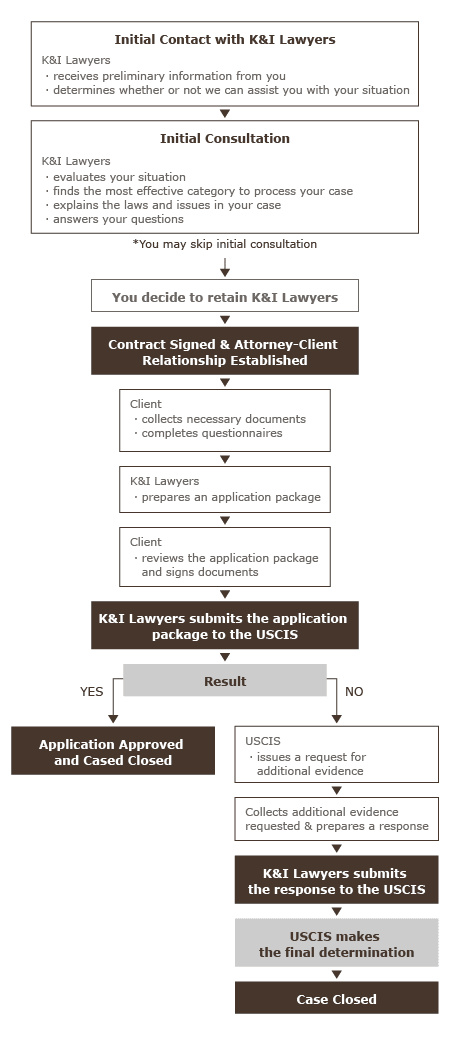
flowchart
×
FAQs about Our Firm

Q: What percentage of your practice consists of immigration law?

A: We practice immigration law almost exclusively. Immigration law is very complex, and fees, policy, interpretation, regulation and law relating to immigration change frequently. Because our practice concentrates on immigration law, you will be secure in knowing that we keep abreast of all the developments in immigration law. All attorneys of the firm are also members of the American Immigration Lawyers Association, which is considered one of the best immigration resources.

Q: I live in Florida, but your office is in Washington. Can you still represent me?

A: Yes. Since immigration law is based on federal law, we can represent you regardless of where you are. In fact, from our office in Washington, we regularly represent both domestic and international clients and communicate with them through email, telephone, fax and mail.

Q: Who handles my case?

A: Either Attorney Rie Kotokawa or Attorney Satoru Isohata will personally or together as a team handle the matters entrusted to them. The legal matters are never turned over to a paralegal or other non-lawyers of our firm.

Q: Do you charge for an initial consultation?

A: Yes. We charge $200.00 for an initial 45 minute consultation. The consultation fee, however, will be credited toward the total attorney fee if you retain our firm within 7 days after the consultation.

Q: Because I live outside the Seattle area, I am not able to come to your office. Is there any other way I can have a consultation with you?

A: Yes. We can provide a consultation over the phone.

Q: If I want a consultation over the phone, how do I pay for the consultation fee?

A: The consultation fee may be paid by Visa or MasterCard.

Q: How do you set your fees?

A: For most cases, we work on a flat fee basis. We will discuss the fees and estimated costs with you thoroughly before commencing the work. A contract will be executed which clearly outlines the fees and estimated costs as well as when you are expected to pay them.

Q: How often do you communicate with clients?

A: As often as necessary. We strongly believe that communication with our clients is one of the most important aspects of our work. We will keep our clients reasonably informed of all developments in their cases. Every effort is made to return all communication from our clients within 24 hours.

Q: Do clients have decision-making authority over their cases?

A: Absolutely. Clients have decision-making authority over their cases at all times. We educate clients regarding the laws and issues in their cases so that they can make informed decisions. We work with clients as a team with each having clearly defined roles and responsibilities. We believe that working together with clients can maximize their chance of success.

Q: Do you provide copies to clients?

A: Yes. We provide clients with copies of all documents prepared or received by the office in connection with their cases.

To the top
Green Card

CONTACT

Send us a message:

6100 219th St. SW, Suite 480, Mountlake Terrace, Washington, 98043 United States

P.O. Box 22, Mountlake Terrace, Washington, 98043 United States

Phone: (206) 430-5108


  1. We take your privacy seriously. All information received from you will be kept strictly confidential and will not be released to a third party without your permission.
  2. The purpose of this online form is for us to receive preliminary information from you. We will review your information and determine whether or not we can assist you with your situation. Every effort is made to contact you within 24 hours with further instructions.
  3. An attorney-client relationship will not be created under any circumstances by simply submitting your email inquires to us. An attorney-client relationship will be established only upon the receipt of a properly executed contract for legal services and the first payment.
  4. Because we receive a large volume of email inquiries, we are not able to answer them if they merely pose questions that have already been answered by materials posted on our website.
  5. Please fill out the online form completely, or we will not be able to contact you.

Name Last Name
First Name
Email
Phone
How Did You Hear About Our Website?: Advertisement  Direct Mail Search Engine
Link From Other Website Newspaper Other
Referral( Person Referred
School/Company Name:
Major/Job Title:
Current Immigration Status:
Inquiry:
Contact Point


DIRECTION TO OUR OFFICE

6100 219th St. SW, Suite 480, Mountlake Terrace, WA 98043


By Car from I-5, take the 220th St. SW Exit (#179). Redstone Corporate Center Building is just on the west of I-5.